Speedup algorithm: Both error bounds and policy iterations
Recall the following basic algorithm of value function iterations:
(1) Set a grid consisting of k and k’ columnwise and rowwise respectively.
(2) Calculate utility for consumption as U using the grid matrix above.
(3) Starting from a certain v, update v1=U+beta*v’ so as to maximize v1.
(4) Repeat (3) by setting v=v1 for many times or until some criterion is met.
(5) Find the final corresponding value of k as k’ according to the maximum value.
Modified algorithm for error bounds is

where
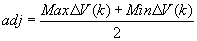
We modify (3) and add the adjustment part to the next.
This adjustment part will converge to zero as the time step goes on.
The additional algorithm of policy iterations is:
(a) Find the corresponding k’ from (3) in value function iterations.
(b) Calculate utility from k and k’ as r.
(c) Starting from a certain vp, update vp1=U+beta*vp where vp=(1/(1-beta))*r.
(d) Repeat the whole thing by setting vp=vp1 until some criterion is met.
We now put together the two. That is, we perform the policy iterations based on
the value function iterations with error bounds.