Value function iterations with transition matrix
We continue to consider the following case with transition matrix

where
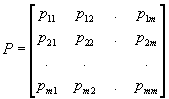
Today we implement policy iterations. Recall the following algorithm:
(1) Set a grid consisting of k and k' columnwise and rowwise respectively.
(2) Calculate utility for consumption as U using the grid matrix above.
(3) Starting from a certain v, update v1=U+beta*v' so as to maximize v1.
(a) Find the corresponding k' from (3) in value function iterations.
(b) Calculate utility from k and k' as r.
(c) Starting from a certain vp, update vp1=U+beta*vp where vp=(1/(1-beta))*r.
(d) Repeat the whole thing by setting vp=vp1 until some criterion is met.
(4) Repeat (3) by setting v=v1 for many times.
(5) Find the final corresponding value of k as k' according to the maximum value.
for a single dimension in 0829.
We now modify the algorithm above for multiple-dimension.
We find
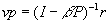 rather than
by matrix inversion across dimensions all at once in each step.
That is implemented by
vp=(inv(eye(dim)-beta*tm)*r')';
for n x dim matrix of r.
The calculation of vp=(1/(1-beta))*r is a special case for single dimension.